Careers

At Durham Academy we have a robust careers programme that is designed to provide independent, objective and informative opportunities for students. We want every student to have the opportunity to progress onto and be prepared for the next stage of their education. Whether this be to pursue A Levels, apprenticeships or courses at local colleges.
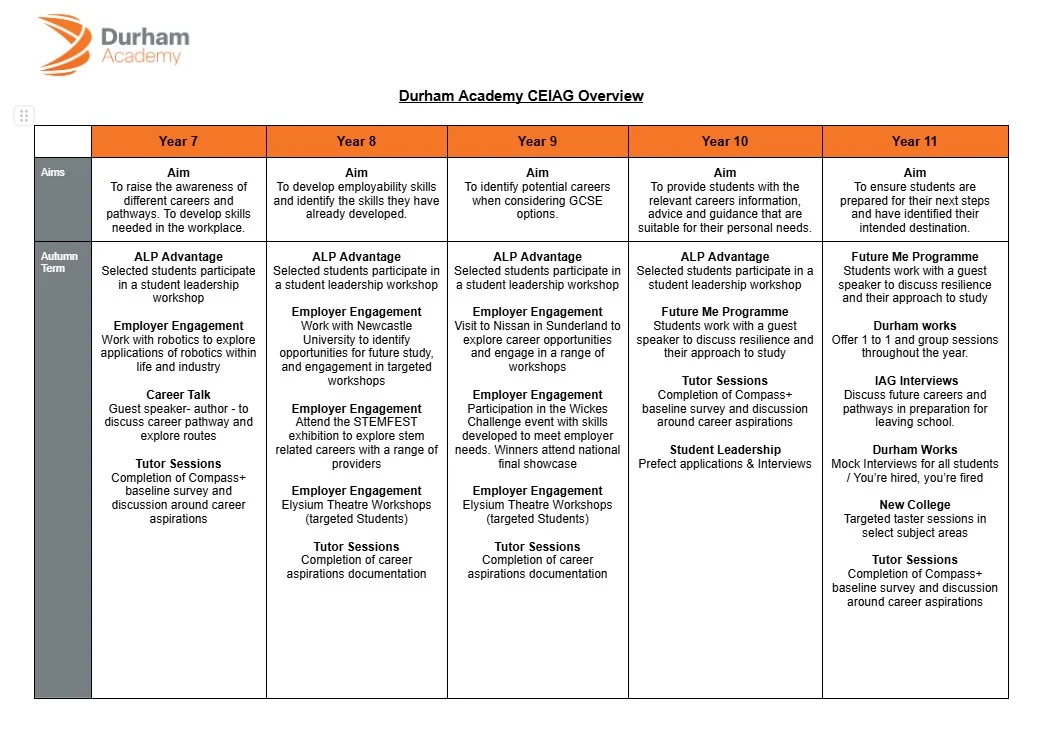
Our Careers Education, Information, Advice and Guidance (CEIAG) programme supports students from Year 7 to Year 11 in developing the knowledge, skills, and confidence needed to make informed decisions about their future.
Local Post 16 Provision
- New College Durham
- Durham Sixth Form Centre
- Bishop Auckland College
- Queen Elizabeth 6th Form College Darlington
- Durham Johnston Sixth Form
- St John’s Catholic School and Sixth Form
- King James I Academy and Sixth Form
- South West Durham Training
- East Durham College
- Darlington College
For any careers advice or guidance please contact Mr S Talbot (Careers Leader) on 0191 373 0336 or via the school email contact@durhamacademy.org.uk.
Careerwave Advice on A-levels
- academic subjects- focused on ideas, theory and knowledge.
- taught in the school classroom environment of Sixth Forms (including School Sixth Form, Sixth Form College, Sixth Form within a College of Further Education).
- assessed by exam.
- can be taken as a package of 3 or 4 OR alongside vocational Level 3 qualifications.
- lead to University or employment including Advanced, Higher and Degree Apprenticeship.
How to get A-level decisions right:
- choose subjects which interest you. If you are interested you are likely to do better.
- it helps if you are good at the subject, or it suits your strengths (in the case of a new subject).
- some subjects go well together and specific combinations are needed for certain degrees and subsequent careers.
- it is ok to mix it up a little. Taking a contrasting subject shows off other talents.
- there are many degrees and careers which do not require any specific subjects or combinations.
- be aware of workload and the demands of each subject and in combination with others.
- there are many misconceptions about what is essential for degrees and careers. Always check out the specific entry requirements for interested courses and Universities.
- a few Universities have lists of preferred and non-preferred subjects.
- competitive courses and Universities might prefer traditional subjects (or facilitating subjects).
- project based work and independent study skills are increasingly valued by Universities. As a result EPQ (Extended Project Qualification) is becoming a popular option alongside 3 A-levels.
- the following articles/guides have been carefully selected to support A-level decision-making;
A Levels Useful Websites
University Useful Websites
https://www.topuniversities.com/courses/engineering/guide
www.ucas.com
www.university.which.co.uk
https://russellgroup.ac.uk
http://www.suttontrust.com
https://www.informedchoices.ac.uk/
Getting an Apprenticeship
- Create an account with ‘Find an Apprenticeship’ at www.gov.uk/apply-apprenticeship.
- Search throughout Year 11. Most employers advertise a few months before the start date. Vacancies with a start after your ‘school leaving date’ are more likely to be advertised from Easter onwards. The very biggest employers may advertise just before or just after Christmas.
- Register with Training Providers and Colleges. Let them help you look for a vacancy. Details of the training provider or college linked to each apprenticeship can be found in the job advertisements on www.gov.uk/apply-apprenticeship. If you see a vacancy which you can’t apply for yet, make sure you directly contact the training provider or college.
- Contact employers. If you or your family knows a local employer who might be interested in taking on an apprentice, you might be the person they wish to employ. Speculatively contacting local businesses is a way to find an apprenticeship, but be warned, it takes a lot of effort for potentially little return.
- Larger companies advertise their apprenticeship schemes on their company website too. If you aspire to work for one of them, then you should go to the ‘Careers’ page of the company website.
- Research the job role, skills and abilities. You need to tell the employer that you have the skills and abilities they are looking for. These websites are recommended for finding out about the skills and abilities needed for each job; nationalcareersservice.direct.gov.uk (Job Profiles), www.startprofile.com (registration needed)
- Find out more about apprenticeships at www.getingofar.gov.uk.
- Cast your net wider. There are several other websites which advertise apprenticeship vacancies and, in some cases, act as an intermediary between you and the employers:
www.notgoingtouni.co.uk
www.getmyfirstjob.co.uk
www.findapprenticeships.co.uk
www.apprenticeshipguide.co.uk
www.careermap.co.uk
www.ratemyapprenticeship.co.uk
Vocational and Technical Qualifications e.g. BTEC, Cambridge Tech, CACHE, City and Guilds. Mainly hands-on and practical learning. Delivered in a simulated work environment and workshops. Mostly assessed by coursework and observations. Theory is taught in classroom and can include some exams. Foundation Learning (Entry Level and Level 1) e.g. Catering, Childcare, Bricklaying, Beauty
- ‘catch all’ term given to Entry Level and Level 1 qualifications.
- in some job-specific trades you start at Level 1 no matter what grades you get e.g. bricklaying.
- personal and social development, vocational pathways, supported employment.
- progression into semi-skilled employment, apprenticeships or Level 2 courses.
- Tech Certs/Levels (Level 2 and 3) e.g. Joinery, Engineering, Plumbing, I.T., Media, Agriculture
- recognised by employers, trade, professional bodies and supported by Universities.
- specialise in an industry or train for a specific job.
- develop specialist knowledge and skills.
- progression from Level 2 to Level 3.
- progression to Apprenticeship, Higher Apprenticeship or Degree Apprenticeship.
- progression to a related Higher Education course e.g. HND, Foundation Degree, Degree.
- progression into employment. Job readiness is the main focus of Technical Qualifications.
Applied Generals (Level 3) e.g. Sport, Health & Social Care, Performing Arts, Applied Science.
- recognised by Universities and supported by employers, trade and professional bodies.
- focus on a wider industry area or career family.
- develop transferable knowledge and skills.
- tend not to provide specialist knowledge and skills for a specific job.
- primarily for students who want to continue their education through applied learning.
- progression to a Higher Education. Continued learning is the main focus of Applied Generals.
- progression into Apprenticeships, Higher Apprenticeship or Degree Apprenticeship.
Apprenticeship & Employment Useful Websites
UCAS Information on Apprenticeships
www.notgoingtouni.co.uk
www.apprenticeships.org.uk
Amazingapprenticeships.com
www.adzuna.co.uk
www.northeastjobs.org.uk