Pupil Premium
Pupil Premium is a sum of money given to schools each year by the Government to improve the attainment of disadvantaged children so that they can reach their full potential.
A Pupil Premium grant is allocated to academies for two separate objectives:
- Raising the educational attainment of disadvantaged pupils of all abilities to help them reach their potential
- Providing support for children and young people with parents in the regular armed forces
Secondary schools are given a Pupil Premium grant for:
- Pupils in Year 7 to Year 11 are eligible for FSM or have been eligible in the past 6 years £1,035 (2024-2025 £1,050)
- Pupils previously looked after by the local authority or other state care £2,530 (2024-2025 £2,570)
- Children who are looked after by the local authority £2,530 (2024-2025 £2,570)
- Service children £335 (2024-2025 £340)
*Funding rates for 2023-24 published on Gov.uk website (funding 2024-25)
Schools can choose how to spend their pupil premium money.
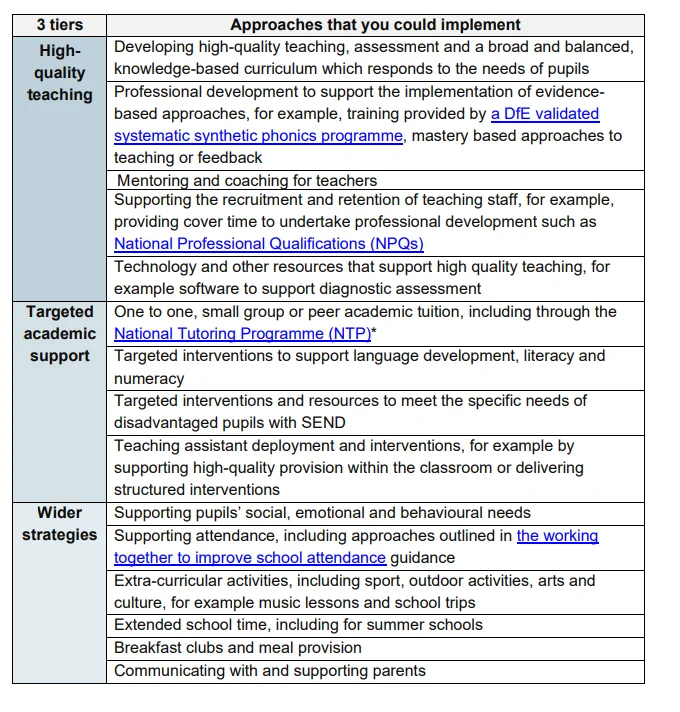
To ensure the Pupil Premium grant is focused on effective approaches to raising the educational attainment of eligible pupils, Durham Academy will use their Pupil Premium grant in line with the ‘menu of approaches’ set by the Department for Education (DfE). The menu of approaches is in the using Pupil Premium guidance.
The menu has been developed in line with the Education Endowment Foundation’s (EEF’s) 3-tiered approach to help schools allocate spending across the following 3 key areas:
- Support high-quality teaching, such as staff professional development
- Provide targeted academic support, such as tutoring, including through the National Tutoring Programme (NTP)
- Tackle non-academic barriers to academic success, such as difficulties with attendance, behaviour and social and emotional wellbeing
How the Pupil Premium funding will be spent:
- Developing high quality CPD
- Running catch-up sessions, for example for children who need extra help with Reading, Writing and Maths
- Funding education trips and visits
- Running a school breakfast club to improve attendance
- Investing in resources that boost children’s learning experience, such as access to laptops or tablets
- Providing music lessons for children whose families would be unable to pay for them
Qualification for Pupil Premium
Children qualify for free school meals – and in turn pupil premium – if parents/carers receive the following benefits:
- Income Support
- income-based Jobseeker’s Allowance
- income-related Employment and Support Allowance
- support under Part VI of the Immigration and Asylum Act 1999
- the guaranteed element of Pension Credit
- Child Tax Credit (provided you’re not also entitled to Working Tax Credit and have an annual gross income of no more than £16,190)
- Working Tax Credit run-on – paid for 4 weeks after you stop qualifying for Working Tax Credit
- Universal Credit – if you apply on or after 1 April 2018 your household income must be less than £7,400 a year (after tax and not including any benefits you get)
Children who get paid these benefits directly, instead of through a parent or guardian, can also get free school meals. If you are unsure please go to the Durham County Council website to complete an application form and get further information. (example of the form attached here)
If you do not qualify for most benefits (also known as having ‘no recourse to public funds’), your child may still be eligible for free school meals. Ask school or your local authority whether they’re eligible.
Schools are responsible for recording the children who are eligible for pupil premium in their annual census – you don’t have to do anything yourself, other than making sure you return any paperwork that is related to the benefits you receive or your child’s entitlement to free school meals.
Further information can be found at Gov Guidance | Pupil Premium.
Please see below the first year of our Pupil Premium Strategy Statement for the 2025–2028 plan.
- Pupil Premium Strategy Statement 2025/26
- Pupil Premium Strategy Review Part B: Review of Outcomes 2024/25


